Are vape cartridges safe to use? The honest answer is not always—and a sealed package cannot prove what is inside. A cartridge’s risks depend on its ingredients, manufacturing quality, heating temperature, and storage. Labels may not reveal every contaminant or how the product behaves when heated. That uncertainty matters.
The National Academies of Sciences, Engineering, and Medicine’s 2018 report, Public Health Consequences of E-Cigarettes, found that e-cigarette aerosols can contain potentially harmful substances, including metals and volatile organic compounds. The CDC’s 2020 investigation recorded 2,807 hospitalizations or deaths related to e-cigarette, or vaping, product use, including 68 deaths. Investigators linked the outbreak primarily to products containing THC and vitamin E acetate. This episode does not show that every cartridge carries the same risk. It does show how quickly poorly understood ingredients can become a public-health concern.
WHO tobacco-control expert Dr. Rüdiger Krech has warned, “E-cigarettes are harmful to health and must be better regulated.” His caution is relevant to cartridges, too. A product’s appearance is not a safety test. Even a familiar flavor, clean mouthpiece, or smooth draw cannot confirm its contents. Not enough.
Readers should look for transparent ingredient information, credible quality testing, and clear manufacturer details, while remembering that these checks cannot guarantee zero risk. People with breathing problems, pregnant people, and those who do not use nicotine should be especially cautious. I would not treat “looks reputable” as proof. Safety claims deserve evidence, not just polished packaging.
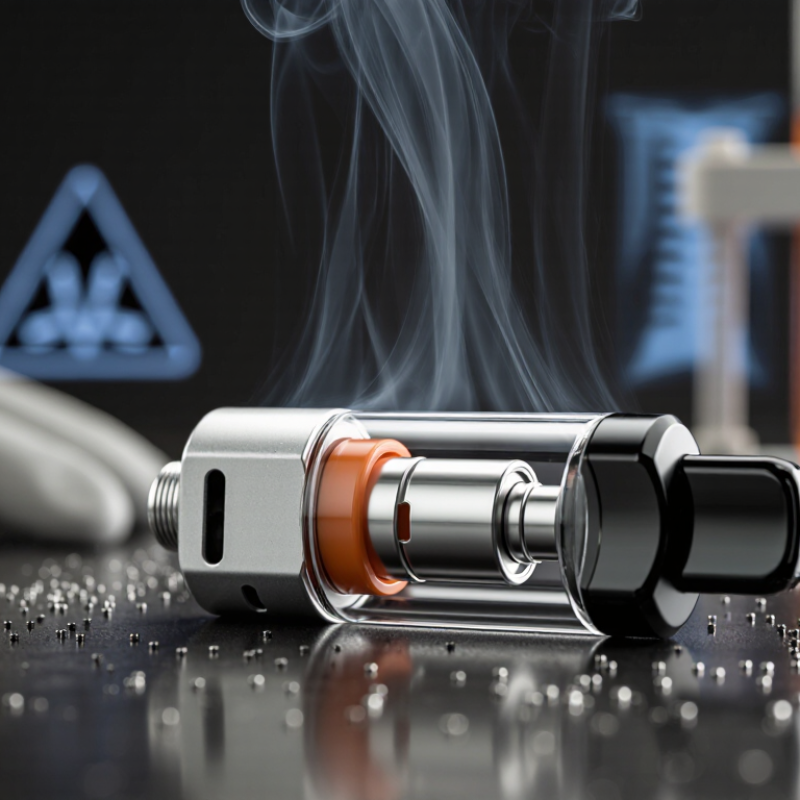
A vape cartridge is more than a small reservoir. Its liquid may contain propylene glycol, vegetable glycerin, nicotine, and flavoring compounds. The proportions differ, and a label cannot show every substance formed during heating. That matters. Heat can change liquid ingredients, especially when a wick is dry or the device runs unusually hot.
The National Academies’ 2018 review examined more than 800 studies. It reported that e-cigarette aerosol can contain metals, volatile organic compounds, and fine particles; levels vary by device and use conditions. Some metals may come from heating components, such as coils. A burnt taste or damaged cartridge is a reason to stop using it, though neither tells you exactly what substances are present. I used to think ingredient lists were enough. They are helpful, but they do not capture the full chemistry of inhaled aerosol.
| Component or factor | What it may contain or do | Why it can matter for safety | What to keep in mind |
|---|---|---|---|
| Active oil or liquid | Depending on the product, the liquid may contain cannabis-derived cannabinoids such as THC or CBD, nicotine, or other ingredients. | Effects and risks vary by substance, concentration, dose, and route of exposure. Labels may not fully describe the contents or their quality. | Do not assume products with different ingredients or intended uses have the same risks. |
| Carrier oils and diluents | Some formulations use thinning or carrier ingredients. Medium-chain triglyceride (MCT) oil has been used in some cannabis products; formulations vary. | Ingredients intended for eating or other uses are not automatically safe to inhale. Heating can also change a substance or produce additional compounds. | Check ingredient information, but remember that a label alone cannot establish inhalation safety. |
| Flavorings and terpenes | Flavor compounds and terpenes may be added to provide aroma, taste, or a particular formulation profile. | Safety data for swallowing a flavoring do not necessarily apply to inhaling it, especially after heating. | A familiar or “natural” flavor does not, by itself, show that an ingredient is safe to inhale. |
| Vitamin E acetate and other additives | Vitamin E acetate was identified in many samples from the U.S. EVALI lung-injury outbreak, particularly samples associated with THC products. | Public health investigations found a strong link between vitamin E acetate in inhaled products and the outbreak; other chemicals may also have contributed. | Vitamin E acetate should not be added to vaping products. Avoid informal or modified products with unknown ingredients. |
| Heating coil, wick, and electrical parts | A cartridge generally uses a heating element and a material that delivers liquid to it. Designs and materials differ. | Heating can release substances from the liquid or device. Under some conditions, e-cigarette aerosols can contain harmful compounds, and device components may contribute metals. | Risk can depend on device design, condition, power, liquid, and how it is used; a cartridge is not simply harmless water vapor. |
| Contamination and manufacturing quality | Products may differ in ingredient accuracy, cleanliness, and possible contamination. Testing and quality controls are not uniform across all sources. | Unlisted ingredients or contaminants can make exposure difficult to assess and may increase health risks. | Products from informal or unverified sources carry particular uncertainty. No label or appearance can guarantee safety. |
| Overall exposure | The aerosol a person inhales depends on the liquid, cartridge, heating conditions, and use pattern. | Inhaling an aerosol can expose the lungs to substances that are absent from the original liquid or present at different levels after heating. | The safest way to avoid vaping-related exposure is not to use vape products. Seek medical care for breathing difficulty, chest pain, or other severe symptoms after use. |
Note: Contents and risks vary by product. This table describes general safety considerations; it does not determine the contents or safety of any specific cartridge.
Its liquid may include propylene glycol, vegetable glycerin, nicotine, and flavoring compounds. The proportions can differ.
No. Heating can change ingredients and create substances that a label may not list. That matters.
Yes. Research has found metals, volatile organic compounds, and fine particles. Levels vary with the device and how it is used.
It can be a reason to stop using the cartridge, but it does not identify the substances present. Not always clear.
Vitamin E acetate was detected in 48 of 51 samples analyzed during a lung injury outbreak. This raised serious concern about its possible role.
No. It does not show that every cartridge contains it or causes harm, and it cannot explain every case.
No. I once assumed clear liquid meant clean contents. That was too simple; contamination and heating conditions can vary.
A new or worsening cough, chest pain, or shortness of breath deserves prompt attention. The full effects of inhaled chemicals remain uncertain.
Vape cartridges can contain concentrated oils, flavoring agents, and other additives, while their heating components may affect what enters the aerosol. Because products and devices vary, their contents and performance are not always predictable. CDC findings during the EVALI outbreak highlighted this variation: 82% of affected patients reported using a particular category of oil-based cartridge products, and vitamin E acetate was detected in 48 of 51 lung-fluid samples examined. These findings point to the importance of considering both the ingredients in a cartridge and how it is heated.
Device-related concerns also include emissions of metals and uncertainty about the amount and type of substances users may inhale. The outbreak had a serious public health impact, with 2,807 reported hospitalizations and 68 deaths. So, are vape cartridges safe to use? Safety cannot be assumed from appearance alone, since ingredients, additives, and device behavior may differ and exposure levels can be difficult to determine.

 Mist Vape